
Occupational Stress
Consultation and Research
- Project OSCAR
Funded by the Health and Safety Executive
Four reports published November 2026
In summary, the research found that:
there is no shared understanding of how work-related stress is defined and labelled
organisational responses to work-related stress are often reactive rather than preventative
effective prevention depends on linking interventions to identified psychosocial risks and involving workers in developing solutions
stronger evaluation and sharing of learning would improve understanding of what works in practice
the key challenge is how existing knowledge is translated into coordinated prevention activity
Role of HR in selecting and
developing senior leaders
2025
For the CIPD

Drawing on academic research and practitioner experience to answer the following questions:
What does good (and poor) senior leadership look like?
What is the link between effective senior leadership and organisational outcomes?
What practices are most effective in selecting and developing senior leaders?
How can HR best support the selection and development of senior leaders?
What organisational structures best facilitate this?
Rad et al., 2025
The first study from my PhD research…
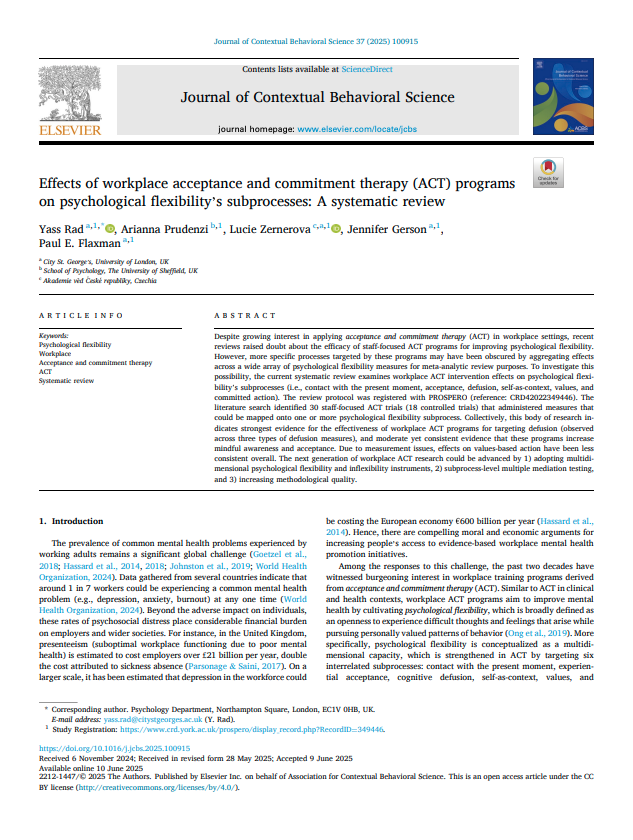
Effects of workplace ACT programs may have been obscured in previous meta-analyses.
In this review, workplace ACT programs were found to improve defusion, present moment awareness, and acceptance.
Longer-term benefits of ACT for staff mental health may be particularly influenced by defusion and acceptance.
Future workplace ACT research should utilize multidimensional measures of psychological flexibility.